

Credible Law Publishes Emergency 48-Hour Guide for Business Owners Served With Merchant Cash Advance Lawsuits
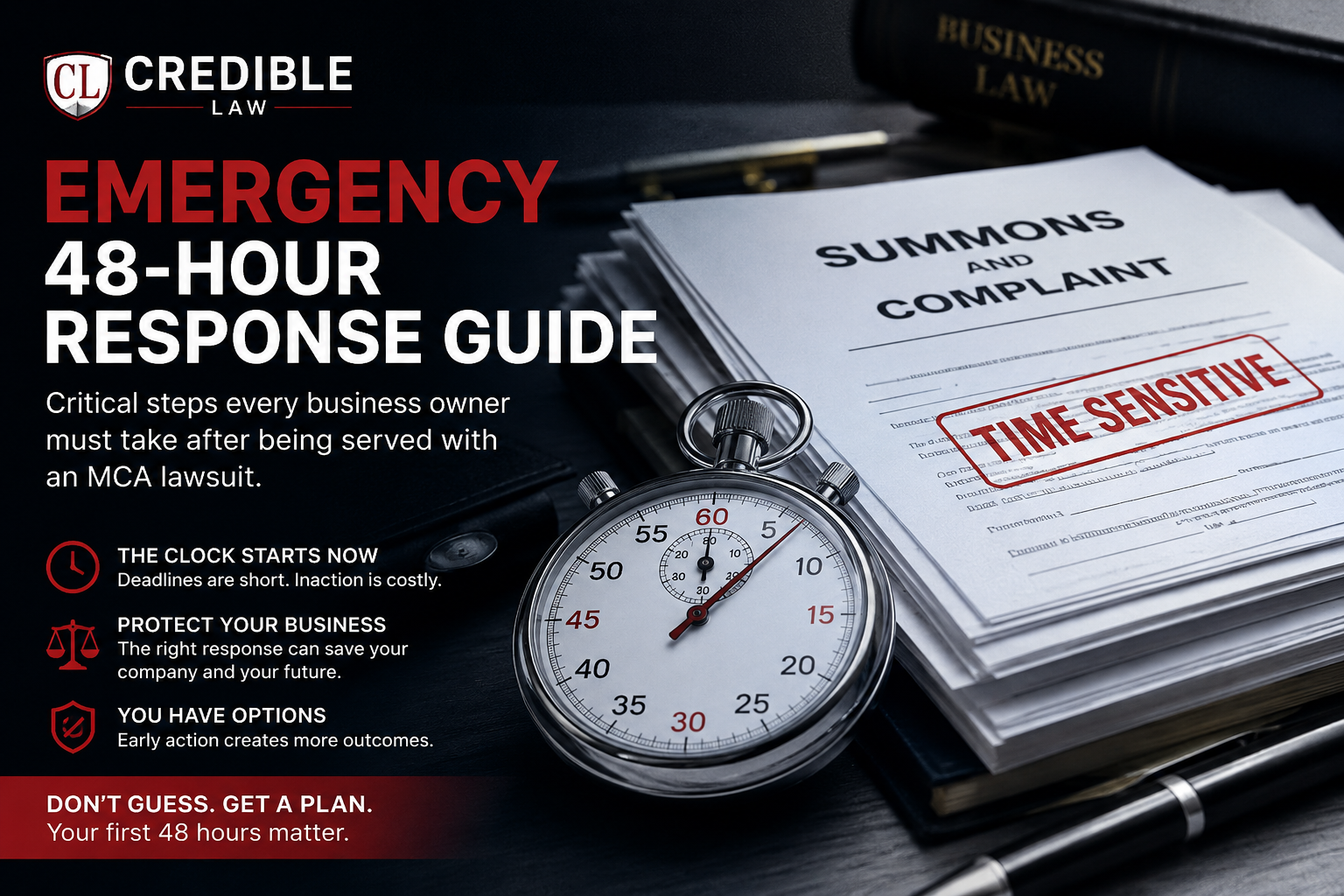
Emergency 48-Hour Response Guide: Business owners facing a Merchant Cash Advance (MCA) lawsuit should act immediately. Credible Law's guide explains the critical first steps to take after being served to help protect your business from default judgments,
New free guide breaks down the critical first 48 hours after an MCA lawsuit, when a missed deadline can mean a frozen account or default judgment.
SAN DIEGO, CA, UNITED STATES, July 20, 2026 /EINPresswire.com/ -- Credible Law, a national merchant cash advance defense referral network, has released a new educational guide addressing one of the most disorienting moments a small business owner can face: the first 48 hours after a merchant cash advance (MCA) funder files suit. The resource breaks the critical two-day window into an hour-by-hour timeline, explaining what typically happens, what is at stake, and what actions preserve a business owner’s legal options before a response deadline lapses or a bank account is frozen.
The guide arrives against a backdrop of increasingly compressed MCA litigation. Unlike ordinary commercial disputes, which can unfold over months, MCA cases are frequently engineered to convert a single missed remittance into an enforceable judgment in a matter of weeks. Funders and their filing counsel work from templates and standardized procedures, and in many cases the first sign of trouble a business owner sees is not a phone call but a frozen operating account. Credible Law’s new resource is designed to close the information gap during the narrow window when informed action still matters most.
“The pattern we see over and over is a business owner who assumes a lawsuit is just aggressive collections and decides to deal with it next month,” a Credible Law spokesperson said. “By the time they focus on it, the response deadline has passed, a default judgment has been entered, and the money is already gone. The first 48 hours are where the outcome is quietly decided, and almost nobody tells business owners that.”
The full resource, what to do in the first 48 hours after an MCA lawsuit, is available on the Credible Law website, where owners can review the complete hour-by-hour breakdown described below.
Why the First Two Days Carry So Much Weight
MCA agreements are structured, at least on paper, as the purchase of a business’s future receivables rather than as loans. That framing has historically allowed the products to sit outside traditional lending rules, including interest-rate caps. But the same framing produces enforcement mechanics that are unusually fast and unusually punishing when a merchant falls behind.
According to Credible Law’s analysis, the compression is deliberate. The faster a case moves, the less time a business owner has to locate qualified counsel, evaluate defenses, and file a timely response — and the more likely the funder is to prevail by default rather than on the merits of the claim. What a business owner does in the first two days does not usually win the case outright, the guide emphasizes. Instead, it determines whether there is still a defensible case to be won at all. Preserve the deadline, preserve the documents, and get the contract in front of the right people, and nearly every available defense remains on the table. Miss the window, and the path narrows to the far more difficult work of vacating a judgment after it has already been entered.
The Hour-by-Hour Breakdown
The new guide organizes the first 48 hours into five distinct windows, each with a specific set of priorities.
Hours 0 to 2: The moment of service. The guide urges owners to immediately record the exact date, time, and method of service, because the response deadline runs from that moment and because defective service is a recognized procedural defense. Owners are advised to preserve the envelope the papers arrived in, photograph every page, identify the court and index number, locate the response deadline printed on the summons, and determine whether the matter is a lawsuit or an arbitration demand — a growing share of MCA agreements now route disputes to arbitration, which follows different rules and timelines.
Hours 2 to 12: Understanding the clock. Response deadlines vary by state and by how service was made, and MCA contracts frequently force out-of-state businesses into a distant forum. The overwhelming majority of MCA agreements contain a forum-selection clause naming New York, which is how a business in Texas or Florida can find itself defending a case in a Manhattan courtroom it has no connection to. As a general guide, New York deadlines commonly run about 20 days for in-state service and 30 days for out-of-state service; New Jersey is often 35 days; Florida is frequently 20 days. The guide stresses that these are general ranges, not a substitute for the specific date printed on a given summons, which should always be treated as authoritative.
Hours 12 to 24: Protecting the bank accounts. Here the guide corrects a widespread misunderstanding. In most states, being sued does not by itself freeze a bank account. An account freeze generally requires a judgment first, followed by a restraining notice or levy served on the bank. The critical exception is a confession of judgment. Where an MCA contract contains an enforceable confession-of-judgment clause, a funder may be able to obtain a judgment and restrain accounts far faster than a normal lawsuit would allow — sometimes before the owner fully understands they have been sued. During this window, the guide advises owners to confirm their account status with the bank, map where their revenue actually flows, and avoid self-help measures such as moving money or unilaterally blocking automated debits, which can trigger default acceleration and, where a personal guarantee exists, expose the owner individually.
Hours 24 to 36: Securing counsel and assembling evidence. By the second day, the guide recommends two parallel tracks: engaging counsel who specifically defends MCA cases, and assembling the documents that counsel will need. It draws a sharp distinction between MCA defense counsel and debt-settlement companies, noting that settlement firms are not law firms and cannot appear in court, challenge a restraining notice, or file the motions that protect a business during the dangerous early phase. The recommended evidence file includes the summons and complaint, the signed MCA agreement and every addendum, any separate confession-of-judgment affidavit, the personal guarantee, recent bank statements and processing reports, and a record of every automated debit and any reconciliation request the owner has made.
Hours 36 to 48: Choosing a response path. The guide clarifies that a formal answer does not need to be filed within 48 hours, and a rushed, defective one should be avoided. But by the end of the second day, an owner and their counsel should have a working view of which path fits: answering and defending on the merits, negotiating from the strength of a documented defense, or moving to address an existing confession of judgment or account restraint through emergency motions.
The Reconciliation Defense Most Owners Never Hear About
Beyond the emergency timeline, Credible Law’s guide draws attention to a substantive defense that frequently reshapes an MCA case — and that many business owners have never heard of until counsel raises it: the right to reconciliation.
Most MCA agreements promise that daily or weekly payments will track the business’s actual revenue through a defined percentage, often called a holdback. Reconciliation is the contractual mechanism that is supposed to align payments with real sales when revenue drops. In practice, many funders collect a fixed amount regardless of what a business actually earns, and some resist or ignore reconciliation requests altogether. Credible Law’s companion resource on MCA reconciliation rights explains why that resistance has become legally significant: when a funder refuses to adjust payments as revenue falls, it may be asserting an absolute right to repayment regardless of business performance — which is a defining characteristic of a loan rather than a genuine purchase of receivables.
That distinction matters because of how courts have approached the question. Where an MCA is recharacterized as a loan, its effective interest rate becomes the central issue, and many MCA products carry effective annualized rates far above traditional usury thresholds. A documented reconciliation denial, paired with evidence of a genuine revenue decline, can therefore become the foundation of a recharacterization argument that reframes the entire dispute rather than merely contesting a balance. For a business owner in the first 48 hours after being sued, the guide notes, the record of past reconciliation requests is often one of the most valuable items in the evidence file — and one of the easiest to overlook under pressure.
A Shifting Legal Landscape
The guide situates its practical advice within a regulatory environment that has changed considerably in recent years. New York’s 2019 amendment to CPLR 3218 restricted the filing of confessions of judgment against non-resident debtors, curbing what had been one of the industry’s most aggressive tools after tens of thousands of such filings were entered against out-of-state businesses. On the disclosure side, roughly ten states — including California, New York, Utah, Virginia, Texas, Florida, Georgia, and others — have now enacted some form of commercial-financing disclosure requirement, several tied to provider or broker registration. California’s SB 362, which phased in through January 2026, added additional transparency requirements around how sales-based financing is presented.
Credible Law cautions that these developments do not automatically resolve any individual case. Whether a specific disclosure gap, forum-selection clause, or confession-of-judgment provision creates a viable defense is a fact-specific legal question that depends on the contract, the state, and the conduct of the funder. But taken together, the guide argues, the trend has expanded the set of arguments available to a well-advised business owner — which is precisely why acting quickly enough to preserve those arguments is so important.
Part of a Broader Educational Library
The 48-hour guide joins a growing library of educational resources Credible Law has published for business owners navigating MCA collection pressure, litigation, and enforcement. The organization’s central merchant cash advance defense resource connects owners with vetted local counsel across the country and serves as a hub for related material on topics including bank levies, UCC liens, default judgments, arbitration, and settlement strategy.
Credible Law has also expanded its state and city-level resources to reflect the reality that MCA enforcement is intensely local. Although a case may be filed in New York, any resulting judgment ultimately has to be enforced where a business banks and operates, which means owners frequently need guidance that spans both the filing forum and their home jurisdiction.
“Our goal with this resource is simple,” the Credible Law spokesperson said. “We want a business owner who was served this morning to understand, by this afternoon, what clock they are on and what to do before it runs out. That knowledge alone changes outcomes.”
About Credible Law
Credible Law is a national merchant cash advance defense referral network. It is not a law firm and does not provide legal advice. The organization connects small and mid-sized business owners facing MCA lawsuits, bank levies, confessions of judgment, UCC liens, and aggressive collection activity with experienced, vetted defense attorneys across the United States. Through its educational resource center, Credible Law publishes guides, reports, and tools designed to help business owners understand their rights and make informed decisions under time pressure.
This press release is provided for informational purposes only and does not constitute legal advice. Response deadlines, enforcement procedures, and available defenses vary by state, by court, and by the specific terms of each contract. The deadline printed on a summons is authoritative. Business owners facing MCA litigation should consult a qualified attorney about their specific circumstances as early as possible.
Kevin Leonard
Optifi.AI Inc
+1 615-243-2754
email us here
Visit us on social media:
LinkedIn
Instagram
Facebook
YouTube
Other
Served With a Merchant Cash Advance Lawsuit? What to Do in the First 48 Hours Before a Default Judgment or Frozen Bank Account
Legal Disclaimer:
EIN Presswire provides this news content "as is" without warranty of any kind. We do not accept any responsibility or liability for the accuracy, content, images, videos, licenses, completeness, legality, or reliability of the information contained in this article. If you have any complaints or copyright issues related to this article, kindly contact the author above.
